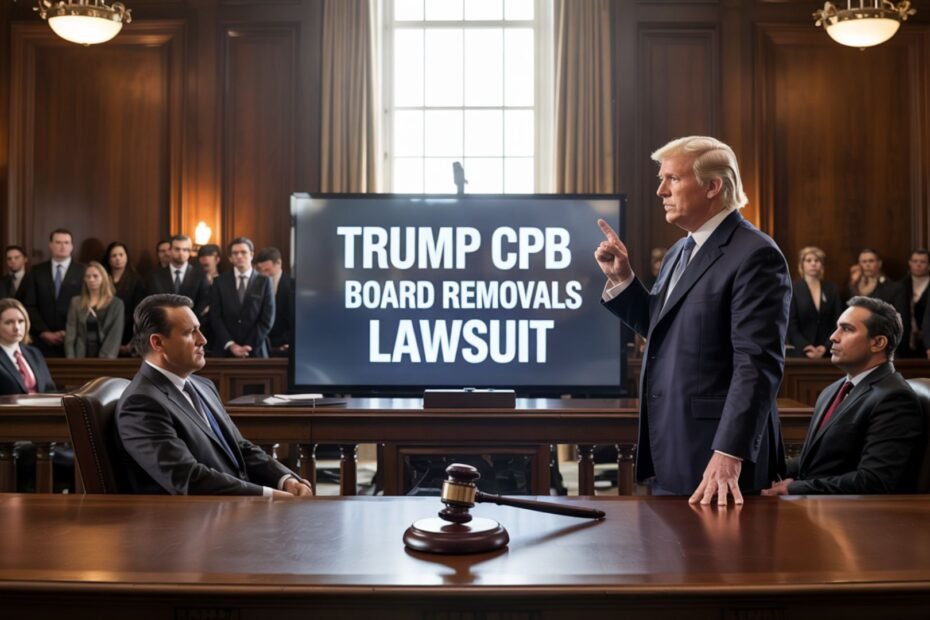
Introduction to the Trump CPB Board Removals Lawsuit
The Trump CPB Board Removals Lawsuit has become one of the most discussed legal battles involving public broadcasting in the United States. At the heart of this lawsuit lies a question of executive authority versus institutional independence. The Corporation for Public Broadcasting (CPB), a nonprofit created by Congress in 1967, oversees the distribution of federal funds to public television and radio stations. Trump’s decision to remove and replace CPB board members before their terms expired sparked heated legal challenges and raised concerns about political interference in public broadcasting.
This article breaks down the timeline, legal arguments, political implications, and media narratives surrounding the case while also providing historical context to understand why this lawsuit matters.
Background: What is the CPB and Why It Matters
The Corporation for Public Broadcasting (CPB) is a federally funded nonprofit organization created to support independent, non-commercial media. Its mission is to:
- Provide funding to PBS (Public Broadcasting Service) and NPR (National Public Radio).
- Promote educational programming.
- Ensure diversity in broadcasting.
- Act as a buffer between politics and journalism.
Because of its critical role, CPB’s governance structure is designed to insulate it from political swings. Board members are appointed by the President but require Senate confirmation, and their staggered terms are meant to overlap administrations.
The Trump CPB Board Removals Lawsuit challenges whether a sitting president can dismiss board members prematurely, undermining that intended independence.
Timeline of the CPB Board Removals Controversy
- 2017–2018: Trump appoints several CPB board members aligned with his administration’s ideology.
- 2019–2020: Growing tensions arise as critics accuse the White House of attempting to reshape public broadcasting.
- 2021: Lawsuit filed against Trump’s actions, alleging unlawful removal of CPB board members.
- 2022–2023: Courts begin hearings, with legal scholars weighing in on presidential authority over independent boards.
- 2024: The Trump CPB Board Removals Lawsuit continues to spark debate over the future of public broadcasting.
Legal Foundations of the Lawsuit
Relevant U.S. Laws and Precedents
- Public Broadcasting Act of 1967 established the CPB as a nonprofit corporation.
- Supreme Court precedents (e.g., Humphrey’s Executor v. United States, 1935) restrict a president’s power to remove certain independent board members.
- Federal Appointment Clause gives the president authority to nominate, but removal powers have long been contested.
Federal Appointment and Removal Powers
The lawsuit hinges on whether CPB is considered a purely executive agency or an independent body with statutory protections. If the latter, Trump may have overstepped constitutional boundaries by removing board members prematurely.
Key Figures in the Trump CPB Board Removals Lawsuit
- Donald Trump – Former President who initiated the removals.
- Removed CPB Board Members – Individuals who filed legal challenges.
- Legal Advocacy Groups – Nonprofits defending CPB’s independence.
- Federal Judges – Deciding whether Trump’s actions violated the law.
Arguments from Trump’s Legal Team
Trump’s lawyers argue that:
- The president has broad executive authority to appoint and remove board members.
- CPB, despite being a nonprofit, relies on federal funding, making it subject to executive oversight.
- Ensuring ideological alignment with administration policies is within presidential prerogative.
Opposition and Critics’ Legal Counterarguments
Critics contend that:
- CPB board members are statutorily protected and cannot be removed at will.
- The Public Broadcasting Act explicitly safeguards CPB’s independence.
- Allowing premature removals would set a dangerous precedent, enabling future presidents to politicize public broadcasting.
Media Coverage and Public Reactions
Conservative vs. Liberal Media Narratives
- Conservative outlets often framed the lawsuit as an attempt to block presidential authority.
- Liberal outlets highlighted the threat to journalistic independence and free speech.
Public reactions have been similarly divided, with some defending Trump’s authority and others warning of political manipulation.

Political Implications of the CPB Board Removals
The lawsuit has major implications:
- Could weaken CPB independence and open the door to partisan broadcasting.
- May influence future appointments across other semi-independent boards.
- Could redefine the limits of presidential power in nonprofit governance.
Impact on Public Broadcasting Policy
If Trump’s removals are upheld, future administrations may feel empowered to restructure CPB at will, undermining the bipartisan vision behind its creation.
Similar Cases in U.S. History
- Humphrey’s Executor v. United States (1935): Limited Roosevelt’s power to remove FTC officials.
- Morrison v. Olson (1988): Addressed removal protections for independent counsel.
- Free Enterprise Fund v. PCAOB (2010): Narrowed removal protections but maintained some independence.
These cases provide legal precedent that may influence the outcome of the Trump CPB Board Removals Lawsuit.
Expert Opinions and Legal Analyses
Legal scholars remain divided:
- Pro-executive authority experts argue that presidents need flexibility.
- Pro-independence experts stress the importance of safeguarding public broadcasting.
External sources like the Brookings Institution provide ongoing analysis of executive authority and governance issues.
FAQs about the Trump CPB Board Removals Lawsuit
Q1. What is the Trump CPB Board Removals Lawsuit about?
A1. It challenges Trump’s decision to prematurely remove CPB board members, questioning presidential authority versus board independence.
Q2. Why is CPB important?
A2. CPB funds NPR and PBS, ensuring public broadcasting remains independent and diverse.
Q3. Has any president done this before?
A3. While presidents have attempted similar removals, the CPB’s nonprofit structure makes this case unique.
Q4. What legal precedents apply?
A4. Cases like Humphrey’s Executor shape the debate over presidential removal powers.
Q5. Could this affect future presidents?
A5. Yes. A ruling in Trump’s favor could grant presidents wider removal powers.
Q6. Where can I read more?
A6. You can explore in-depth legal analyses on sites like Lawfare.
Conclusion: Future Outlook on CPB Governance
The Trump CPB Board Removals Lawsuit is more than a legal battle—it’s a test of the balance between presidential authority and institutional independence. Whether the courts side with Trump or the dismissed board members, the outcome will shape the future of public broadcasting and nonprofit governance in the U.S.
This lawsuit underscores the need to protect independent institutions while also defining clear limits on executive power. The final ruling will not only affect CPB but could reshape the relationship between presidents and semi-independent boards for decades to come.